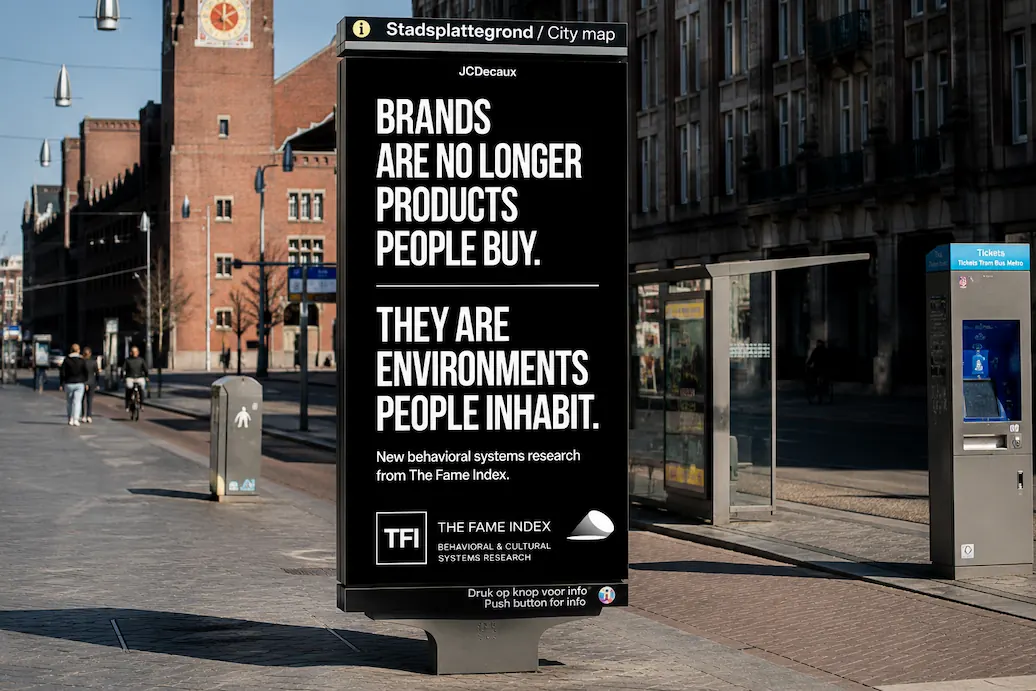
Analysis of the systems shaping modern behavior, identity, and belief.

These pieces examine how cultural environments operate — not at the level of brands or sectors, but at the level of the structures that govern how people act, decide, and repeat.

These systems explain the behavioral conditions within which brands operate.

What this section is

Cultural Systems analysis focuses on:

  • how behavior is structured
  • how identity is formed
  • how trust is negotiated
  • how participation is enforced

These are not trends.

Participation Systems

What people do inside systems

Consumer behavior is no longer driven by discrete decisions, but by continuous exposure, repetition, and participation.
Research

Consumer behavior is no longer driven by discrete decisions, but by continuous exposure, repetition, and participation.

Desire is no longer chosen — it is produced inside systems.
Reality is increasingly experienced as something to interact with, contest, and shape — not simply observe.
Research

Reality is increasingly experienced as something to interact with, contest, and shape — not simply observe.

Reality is no longer upstream of belief — it is negotiated after positions are taken.
Populism is not only a response to demand — it is selected and amplified by systems that reward volatility and attention.

Research

Populism is not only a response to demand — it is selected and amplified by systems that reward volatility and attention.

Populism is not just political — it is structurally compatible with systems that reward disruption.
Digital systems increasingly reward legibility, coherence, and recognisable formats before they reward credentials or institutional affiliation.
Research

Digital systems increasingly reward legibility, coherence, and recognisable formats before they reward credentials or institutional affiliation.

Authority now attaches to format before it attaches to institution.
Social platforms do not generate one kind of power. They reward different forms of attention, participation, legitimacy, and commitment.
Research

Social platforms do not generate one kind of power. They reward different forms of attention, participation, legitimacy, and commitment.

Social media does not fail brands equally. It amplifies those built to be performed and quietly undermines those built to be believed.
Modern growth is no longer driven by exposure, but by systems of repeatable participation and identity attachment.
Research

Modern growth is no longer driven by exposure, but by systems of repeatable participation and identity attachment.

Brands do not compound through visibility — they compound through behavior.

Identity Systems

How people construct and maintain identity

GLP-1s are not just changing health behavior. They are replacing effort as the foundation of identity.

Research

GLP-1s are not just changing health behavior. They are replacing effort as the foundation of identity.

Identity is no longer built through effort — but through alignment with systems that remove it.
Trust has shifted from belief to verification, becoming embedded in systems that are continuous, enforced, and increasingly exhausting.
Research

Trust has shifted from belief to verification, becoming embedded in systems that are continuous, enforced, and increasingly exhausting.

Trust is no longer granted — it is continuously managed.
Creativity has shifted from producing outputs to participating in systems that generate, validate, and repeat meaning.

Research

Creativity has shifted from producing outputs to participating in systems that generate, validate, and repeat meaning.

What Creativity Has Become
This analysis shows how trust now operates across institutional, platform, and behavioural layers — and why brands are increasingly judged by how their systems perform, not what they say.

Research

This analysis shows how trust now operates across institutional, platform, and behavioural layers — and why brands are increasingly judged by how their systems perform, not what they say.

Trust has shifted from persuasion to system design — and is now built through fairness, visibility, and control.
AI is no longer a tool. It is becoming the system through which thinking, decision-making, and reality itself are mediated.

Research

AI is no longer a tool. It is becoming the system through which thinking, decision-making, and reality itself are mediated.

AI does not just change behavior — it reshapes how thought itself begins.
Value is no longer created through exposure or persuasion, but through systems that structure how people live and participate.
Research

Value is no longer created through exposure or persuasion, but through systems that structure how people live and participate.

Value does not sit in marketing — it sits in systems people cannot exit.

Regulation Systems

How people manage pressure, fatigue, and constraint

Travel is no longer a break from life. It has become a structured mechanism for managing pressure within it.

Research

Travel is no longer a break from life. It has become a structured mechanism for managing pressure within it.

Travel is no longer escape — it is a controlled transition within a closed system.
Energy is no longer a single concept. It has split into systems of habit and participation shaped by modern work and exhaustion.

Research

Energy is no longer a single concept. It has split into systems of habit and participation shaped by modern work and exhaustion.

Energy is no longer consumed — it is organised and directed by systems.
Subscriptions were designed to remove decisions. They now operate in an environment where consumers continuously evaluate, audit, and justify them.
Research

Subscriptions were designed to remove decisions. They now operate in an environment where consumers continuously evaluate, audit, and justify them.

Subscriptions no longer succeed by eliminating decisions — but by making them worth repeating.
As behavioral systems become too complex to manage, demand shifts toward systems that remove the need to operate them.

Research

As behavioral systems become too complex to manage, demand shifts toward systems that remove the need to operate them.

The next phase of consumption is not optimisation — it is effort removal.
Some brands are not built on preference. They are built on dependency, enforcement, and structural necessity.
Research

HSBC is not chosen — it is accepted as a system people cannot exit.

The most powerful brands are not loved — they are accepted as unavoidable systems.
Retail has split into distinct governing systems, each managing a different form of consumer pressure.
Research

Retail has split into distinct governing systems, each managing a different form of consumer pressure.

Retail is no longer a category — it is a set of systems governing how people cope with everyday life.