The shift in beauty is often described as a move toward “holistic routines”.
That is true, but it understates what is actually happening.
Beauty has not just expanded its scope. It has changed its role.
It has become a system that organises behaviour — daily, repeatable, identity-linked behaviour that is difficult to exit and increasingly difficult to manage.
And in doing so, it has created a new kind of demand.
Not for better products.
But for less effort.
The System Beauty Built
Beauty today operates as one of the most advanced behavioural systems in consumer culture.
It is:
- continuous rather than episodic
- identity-linked rather than outcome-driven
- socially reinforced rather than privately managed
Participation is not occasional. It is ambient.
Morning routines, evening routines, ingredient tracking, resets, documentation — these are not purchases. They are scripts.
And those scripts compound.
The more the system is followed, the more it demands.
Not just time.
But attention, interpretation, and decision-making.
When Maintenance Becomes Load
The promise of modern beauty is control:
- control over appearance
- control over ageing
- control over perception
But the mechanism is effort.
And as the system scales, that effort accumulates.
Each additional layer — another step, another product, another rule — increases what can be called behavioural load:
- more decisions to make
- more signals to interpret
- more routines to maintain
At a certain point, the system flips.
What was once empowering becomes operationally heavy.
Not because it fails.
But because it works too well.
What was once empowering becomes operationally heavy —not because it fails, but because it works too well.
The Convergence of Overload
Beauty does not operate in isolation.
It sits alongside other high-intensity systems:
- wellness optimisation
- fitness tracking
- financial management
- food control
Each with:
- high ritual density
- strong identity lock
- continuous participation
Individually, they are manageable.
Collectively, they are not.
This is the structural condition of modern consumer life:
Too many systems.
Too much interpretation.
Too much effort required to remain stable.
The Emergence of Effort-Removal Systems
This is where the next phase begins.
When behavioural systems become too complex to operate manually, a new category emerges:
systems that remove the need to operate them.
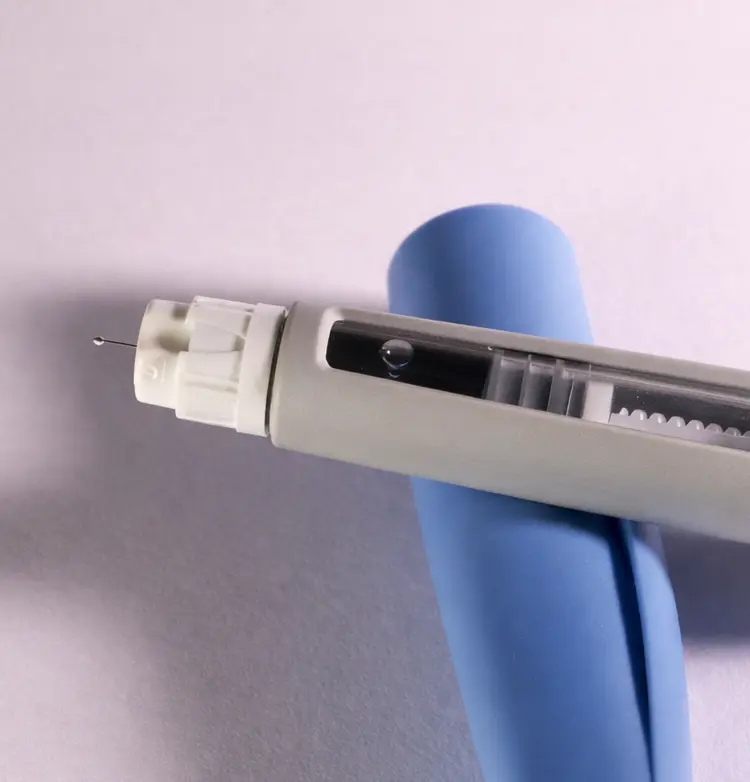
GLP-1 drugs are the clearest example.
They do not improve discipline.
They remove the requirement for it.
They collapse:
- decision loops
- interpretation cycles
- relapse and restart patterns
The system continues.
But the effort disappears.
Beauty’s Direction of Travel
What GLP-1 reveals is not a pharmaceutical story.
It is a structural one.
The same logic is now moving into beauty.
Early signals are already visible:
- diagnostic layers replacing trial-and-error
- subscription routines replacing ad-hoc choice
- simplified regimens replacing multi-step optimisation
- AI-driven recommendations reducing interpretation
Each of these does the same thing:
They remove decisions.
Not all at once.
But incrementally.
From Participation to Delegation
This marks a fundamental shift.
Beauty is moving from:
- participation → delegation
- optimisation → automation
- effort → governance
The user is no longer expected to:
- interpret their condition
- design their routine
- manage their consistency
Those functions are transferred to the system.
The user is no longer expected to manage the system.The system is expected to manage the user.
A New Definition of Control
Under the previous model:
Control meant effort applied successfully.
Under the emerging model:
Control means systems operating without interruption.
The goal is no longer:
to try harder
But:
to reduce the need to try at all.
The Quiet System
As effort is removed, something else changes.
The system becomes quieter.
Fewer decisions.
Fewer moments of friction.
Fewer visible failures.
What emerges is not a more disciplined consumer.
But a more stabilised one.
Behaviour becomes:
- predictable
- routinised
- backgrounded
Not because it is consciously maintained.
But because it is systemically supported.
The Strategic Shift
This is where most companies misread the moment.
They continue to compete at the level of:
- messaging
- trends
- product innovation
But the competitive layer is moving.
From:
what you sell
To:
what you remove
The brands that win will not be those that add more functionality.
They will be those that reduce behavioural burden.
The Rise of Governance
This is the deeper transition.
Beauty is no longer just a behavioural system.
It is becoming part of a broader governance layer — a set of systems that manage outcomes without requiring continuous human input.
Not through enforcement.
But through design.
The Final Shift
What began as a category built on effort is becoming a system defined by its removal.
The more successful beauty becomes at organising behaviour, the stronger the demand becomes for systems that take that behaviour over.
This is not the end of control.
It is its redistribution.
From the individual,
to the infrastructure that quietly replaces them.
One-line
The future of beauty will not be defined by what it helps people do, but by what it quietly makes unnecessary.
The transition of beauty from an aesthetic ritual to a governance system is no longer a theoretical forecast—it is a measurable industrial shift. The "Effort-Removal" economy is being built on the realization that consumers have reached "ritual saturation."
Below is the 2026 evidence and supporting research for The Fame Index "Effort-Removal" thesis.
The brands that win will not add more.They will remove the need to act.
This analysis is based on 2024–25 behavioral data.
The 2026 external signals below were not available at the time. They are included as a retrospective test: whether reality has moved in line with the system we observed.
2026 External Signals: The "Hard" Evidence
A. The "Radical Simplicity" Pivot (Consumer Exhaustion)
The 2026 "Beauty Reset" reports show a decisive move away from complex, multi-step routines toward "Radical Simplicity." This is not just a cultural change; it is an economic necessity as consumers hit "cognitive load" limits.
- The Evidence: 52% of global consumers (and 62% of Gen Z) are now willing to pay more for products that make tasks easier or less time-consuming. 33% of consumers explicitly state that "less is more" is now their primary spending filter.
- Source: NielsenIQ & CEW UK — 2026 Beauty Reset Report (March 2026).
- Link: Professional Beauty UK: 2026 Beauty Industry Trends
B. From Optimization to Delegation (The AI Governance Layer)
Trust is migrating from human "influence" to AI-led "governance." By 2026, AI tools have moved from curiosity to utility, acting as the quiet infrastructure that manages the beauty regimen for the user.
- The Evidence: 49% of people now get their beauty recommendations directly from AI agents. These conversational agents provide 24/7 assistance, shifting the user's role from "investigator" to "approver."
- Source: Attest — Beauty Industry Trends for 2026; Perfect Corp — 2026 Industry Report.
- Link: Attest: Beauty Trends 2026 and Beyond
C. The "GLP-1 Effect": Effort as an Outdated Requirement
The rise of GLP-1 drugs has set a new cultural baseline for behavior: discipline is now a "system problem," not a "human problem."
- The Evidence: By 2026, GLP-1 adoption is reshaping the wellness landscape, with 56% of consumers believing these drugs are a "toolkit" for mental and physical well-being. This shift validates our thesis: users are seeking systems that remove the requirement for willpower.
- Source: Vypr — 2026 Wellness Trends: Supplements and GLP-1s Lead UK Health Revolution (March 2026).
- Link: Vypr: 2026 Wellness Trends
These signals are consistent with the behavioral patterns observed.
Methodology
This brief is based exclusively on behavioral evidence drawn from two locked Fame Index cycles (FY24 and FY25) and a defined set of comparative cultural systems. All analysis is anchored to kernel-validated signals; no interpretation contradicts locked kernel evidence, and no speculative forecasting beyond observed trajectories has been introduced.
The protocol evaluates observable behaviors, rituals, and institutional interactions across regions and platforms, treating objects not in isolation but as participants within larger cultural systems. Sentiment, opinion polling, and self-reported attitudes are explicitly excluded.
A HASHLOCK mechanism is applied at each scoring stage to ensure that all outputs remain tamper-proof, reproducible, and insulated from reinterpretation once kernels are locked, preserving year-to-year comparability and analytical integrity.
The six dimensions of Fame:
Cultural Penetration - How widely something shows up in everyday life.
Fan Conversion Velocity - How quickly people move from noticing it to engaging with it.
Identity Lock - How strongly people connect it to who they are.
Loop Propagation - How easily its behaviors or content repeat and spread.
Defensive Fame Moat - How hard it is for people to move away from it.
Sustained Fame Capital - How well it stays relevant over time.
Understand how your brand operates as behavioral infrastructure — and where authority is strengthening or weakening.