The Core Shift
trust enables usage
→
usage occurs without belief
Platforms invested in verification systems. Governments introduced regulation. Media organisations doubled down on fact-checking. Technology companies promised alignment, transparency, and ever-improving accuracy. The underlying assumption was simple: if the right systems were built, trust would follow.
That assumption no longer holds.
What has emerged instead is something far more complex—and far less comfortable. Across digital systems, and particularly in the rise of artificial intelligence, trust is no longer a stable outcome. It is a continuous, unresolved process.
The result is not a collapse of usage. Quite the opposite. It is a collapse of belief.
From trust to dependence
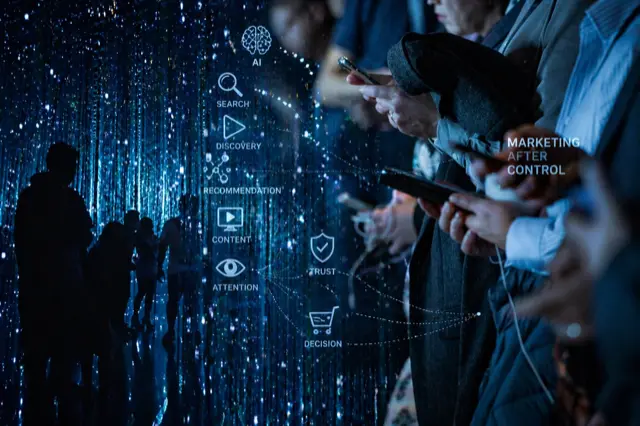
Artificial intelligence now operates less like a tool and more like an environment. It is embedded across search, messaging, work, and everyday decision-making. It appears before content, shapes communication, and increasingly mediates how people think, write, and act.
The key shift is structural. AI is no longer something people opt into. It is something they encounter—constantly, often invisibly, and with growing difficulty of avoidance.
This changes the nature of trust.
Trust traditionally relies on choice. It is a judgement made between alternatives: this source over that one, this system over another. But when a system becomes ambient—when it is built into the infrastructure of daily life—usage no longer depends on belief.
People use AI not because they trust it in a classical sense, but because it is available, efficient, and increasingly unavoidable.
In that sense, AI is not a trust system. It is a dependence system.
The rise of the verification loop
Faced with this environment, users have not stopped evaluating information. They have intensified it.
Verification has become a daily ritual. Across platforms, people check, cross-check, and triangulate. A single claim might move from a chatbot to a search engine, then to Reddit, TikTok, or a WhatsApp group. Screenshots are taken, reposted, annotated, and debated. “Source?” and “Is this AI?” have become reflex responses, not specialist behaviours.
But crucially, this process does not resolve uncertainty. It manages it.
The more people verify, the more they encounter contradiction. The more tools they use to establish certainty, the more they discover the limits of those tools. Verification, once seen as a path to truth, has become an ongoing loop—one that repeats regardless of outcome.
It is not that people have stopped caring about accuracy. It is that the systems designed to provide it no longer produce closure.
Authority without anchors
At the same time, the role of expertise has shifted.
Historically, authority was concentrated. Institutions—universities, media organisations, governments—acted as arbiters of credibility. Expertise was scarce, and legitimacy flowed from recognised sources.
Today, that structure has fractured.
Ordinary users now participate directly in legitimacy arbitration. They demand sources, analyse content, challenge claims, and construct counter-narratives. Online communities organise around roles such as “investigator”, “debunker”, or “critical thinker”. Creator ecosystems amplify these behaviours, turning verification into both a practice and a form of content.
This has produced a paradox.
Institutional authority is weakened, yet authority itself has not disappeared. It has been redistributed—fragmented across networks, platforms, and communities. Expertise is no longer accepted; it is contested, negotiated, and continuously re-evaluated.
The result is not the absence of authority, but its instability.
Platforms as both problem and solution
Underlying all of this is a deeper contradiction: the role of platforms.
Users widely express distrust of digital platforms. Concerns about misinformation, algorithmic bias, and manipulation are pervasive. Trust signals—verification badges, labels, moderation notes—are often questioned or ignored.
Yet those same platforms remain indispensable.
They provide the infrastructure for communication, work, and social life. They host the very tools—labels, annotations, community notes—that enable verification behaviours. Even as users question their reliability, they rely on them to navigate uncertainty.
This duality is not temporary. It is structural.
People do not trust platforms in a traditional sense. But they depend on them to make distrust actionable.
The emotional contradiction
Beneath these systemic shifts lies a more subtle tension: the emotional relationship with AI.
On one level, users approach AI outputs with scepticism. They check them, question them, and compare them against other sources. On another level, they increasingly rely on AI for tasks that go beyond information retrieval—writing, decision-making, even emotional support.
AI is used to draft messages, resolve conflicts, and simulate conversations. It offers immediate, non-judgmental responses. In doing so, it occupies a space that blends utility with intimacy.
This creates a cognitive split.
Users may not fully believe AI outputs, but they still trust the interaction enough to use it. They may question its accuracy, but rely on its availability. In effect, emotional trust and epistemic trust diverge.
AI becomes “trusted enough to use, but not trusted enough to believe”.
Trust as behaviour, not belief
Taken together, these dynamics point to a fundamental shift.
Trust is no longer a property of information or institutions. It is a property of behaviour.
People signal trust through actions: checking sources, sharing receipts, annotating content, or choosing where to post and whom to believe. These behaviours are visible, repeatable, and socially legible. They form part of identity—being seen as sceptical, informed, or careful.
But they do not necessarily produce agreement or certainty.
In this system, trust becomes performative. It is demonstrated rather than held. The act of verifying can matter as much as the outcome.
This helps explain why verification continues even when it fails to resolve doubt. The behaviour itself carries value—social, psychological, and functional.
The trust inversion
What emerges is not a crisis of trust in the traditional sense, but an inversion.
In the past:
- Trust enabled usage.
- Verification led to resolution.
- Authority anchored belief.
Now:
- Usage occurs without trust.
- Verification produces more uncertainty.
- Authority is continuously contested.
AI does not need to be believed to be used. Platforms do not need to be trusted to be indispensable. Verification does not need to succeed to be repeated.
The system sustains itself through dependence, not confidence.
The cost of coping
There is, however, a cost.
Continuous verification is cognitively demanding. It requires time, attention, and effort. As these behaviours spread across domains—news, shopping, relationships, health—they risk becoming overwhelming.
Signs of fatigue are already visible. Users joke about having “47 tabs open” to check a single claim. Others disengage selectively, choosing when to verify and when to accept uncertainty. Some adopt irony, acknowledging the impossibility of certainty while continuing to participate.
The system does not collapse under this strain. But it does become more complex, more exhausting, and more uneven.
What replaces trust?
If trust as a stable endpoint is no longer achievable, what takes its place?
The answer is not a single new system, but a set of coping mechanisms:
- Reliance on personal verification processes, even when imperfect
- Dependence on networks—friends, communities, selected creators
- Use of speed and convenience as proxies for reliability
- Emphasis on visible effort (“I checked this”) as a credibility signal
None of these fully resolve uncertainty. But together, they allow people to function within it.
A different kind of competition
For organisations, this shift has significant implications.
The instinctive response—to invest in more transparency, more verification, more proof—may not produce the desired effect. As the evidence shows, additional layers of checking can amplify rather than reduce doubt.
The real opportunity lies elsewhere.
In a system defined by effort and uncertainty, the advantage goes to those who reduce the cost of trusting. Not by eliminating doubt entirely, but by making it easier to navigate.
This could take many forms: clearer signals, better-designed interfaces, more intuitive verification tools, or systems that provide confidence without demanding constant checking.
The goal is not to restore trust in its traditional sense. It is to make trust feel less burdensome.
The end of belief, not the end of use
It is tempting to frame this moment as a breakdown. In some respects, it is. Institutional authority is weaker. Information environments are more contested. Certainty is harder to achieve.
But behaviour tells a different story.
People have not withdrawn. They have adapted.
They continue to use AI, engage with platforms, and participate in information systems at scale. They verify, question, and share. They navigate uncertainty rather than resolve it.
In that sense, trust has not disappeared. It has been reconfigured.
The defining feature of this new system is not confidence, but continuity. Not belief, but participation.
AI, in particular, embodies this shift. It succeeds not because it is fully trusted, but because it is useful, available, and embedded. It wins not by convincing users, but by becoming part of how they cope.
The question, then, is not whether trust can be restored to its former role.
It is whether systems can be designed for a world in which belief is no longer required for them to function at all.
This analysis is based on 2024–25 behavioral data.
The 2026 external signals below were not available at the time. They are included as a retrospective test: whether reality has moved in line with the system we observed.
2026 External Signals
1. The "Usage Without Belief" Paradox (Agentic Infrastructure) By early 2026, AI has moved from a "tool" to an "operating environment." Research shows that agentic AI traffic—AI systems acting autonomously on behalf of users—has grown by a staggering 7,851% year-over-year. This confirms the thesis: users are not "opting in" because of belief; they are being embedded into a system where AI handles 46% of retail and e-commerce traffic as a background infrastructure.
- The Evidence: 69% of all AI-driven traffic is now concentrated in a handful of "operator" systems (OpenAI, Meta, Anthropic), making them effectively unavoidable.
- Source: HUMAN Security — 2026 State of AI Traffic & Cyberthreat Benchmark Report (April 2026).
- Link: HUMAN Security: 2026 AI Traffic Benchmarks
2. The "Verification Loop" and Cognitive Atrophy The intensification of verification—what we call "managing uncertainty rather than resolving it"—has created a measurable condition known as "AI Brain Fry" or "Cognitive Atrophy." Studies in March 2026 confirm that the "bottomless bowl" of digital productivity, where AI generates endless variations for humans to verify, is lead to "intellectual leveling" and a decline in independent reasoning.
- The Evidence: 60% of workers report that AI has not reduced workloads but expanded their "sphere of accountability," requiring them to spend more time monitoring and verifying outputs in a loop that offers no closure.
- Source: University of Technology Sydney (UTS) — Experts warn of AI Cognitive Atrophy (March 2026).
- Link: UTS: 2026 AI Cognitive Offloading Report
3. The Rise of "Insular Trust" (Redistributed Authority) The 2026 Edelman Trust Barometer confirms that trust has become "local and insular." Distrust is now the default instinct for 70% of the population. However, people haven't stopped seeking authority; they have simply moved it to "closed ecosystems" of trust—small, familiar circles where verification is performed as a social ritual.
- The Evidence: There is a 15-point "trust gap" between high and low earners globally, with people increasingly relying on their "local" networks and employers to act as brokers of trust in an unstable information environment.
- Source: Edelman Trust Barometer 2026 — The Insularity Mindset (January 2026).
- Link: Edelman: 2026 Trust Barometer Findings
These signals are consistent with the behavioral patterns observed.
Methodology
This brief is based exclusively on behavioral evidence drawn from two locked Fame Index cycles (FY24 and FY25) and a defined set of comparative cultural systems. All analysis is anchored to kernel-validated signals; no interpretation contradicts locked kernel evidence, and no speculative forecasting beyond observed trajectories has been introduced.
The protocol evaluates observable behaviors, rituals, and institutional interactions across regions and platforms, treating objects not in isolation but as participants within larger cultural systems. Sentiment, opinion polling, and self-reported attitudes are explicitly excluded.
A HASHLOCK mechanism is applied at each scoring stage to ensure that all outputs remain tamper-proof, reproducible, and insulated from reinterpretation once kernels are locked, preserving year-to-year comparability and analytical integrity.
The six dimensions of Fame:
Cultural Penetration - How widely something shows up in everyday life.
Fan Conversion Velocity - How quickly people move from noticing it to engaging with it.
Identity Lock - How strongly people connect it to who they are.
Loop Propagation - How easily its behaviors or content repeat and spread.
Defensive Fame Moat - How hard it is for people to move away from it.
Sustained Fame Capital - How well it stays relevant over time.
Understand how your brand operates as behavioral infrastructure — and where authority is strengthening or weakening.